Understanding µmol/J, PPF, PPFD, and PPE
Stop Confusing the Numbers
One of the biggest problems in the grow-light market today is that people throw around terms like
PPF, PPFD, PPE, and µmol/J without actually understanding what they mean.
Companies abuse these numbers in marketing, influencers repeat them without context, and growers
end up comparing things that are not even remotely comparable.
So let’s clear this up.
µmol/J (Micromoles Per Joule)
µmol/J is the efficiency of the fixture.
It tells you how many usable photons the fixture produces for every watt of electricity consumed.
Think of it like miles per gallon for grow lights.
If a light is rated at:
- 2.5 µmol/J → it produces 2.5 micromoles of photons per joule of energy
- 3.0 µmol/J → it produces 3 micromoles of photons per joule
- 3.2 µmol/J → extremely efficient fixture
The higher the number, the more photons you get per watt of power.
Example:
A fixture drawing 800 watts at 3.1 µmol/J
800 × 3.1 = 2480 µmol/s PPF
So efficiency and total output are directly connected.
But this number only tells you efficiency, not how evenly the light is distributed
over your canopy.
PPF (Photosynthetic Photon Flux)
PPF is the total number of photosynthetic photons the fixture produces per second.
This is measured in:
µmol/s (micromoles per second)
PPF tells you how much light the fixture produces overall, not where it lands.
Example:
Light A
- 600 watts
- 2.8 µmol/J
600 × 2.8 = 1680 µmol/s PPF
Light B
- 800 watts
- 3.1 µmol/J
800 × 3.1 = 2480 µmol/s PPF
Light B produces more total photons, so it can light a
larger canopy or achieve higher PPFD.
But again, PPF does not tell you distribution.
You can have a high-PPF fixture that produces a terrible canopy map.
Distribution matters.
PPFD (Photosynthetic Photon Flux Density)
PPFD is the amount of photons hitting a specific area.
This is measured in:
µmol/m²/s
This is the number growers actually care about because it tells you
how much light your plants are receiving.
Example canopy values:
- Veg: 300–600 PPFD
- Flower: 700–1100 PPFD
- High CO₂ rooms: 1200–1700+ PPFD
PPFD depends on several factors:
- Fixture output (PPF)
- Hanging height
- Optics and spread
- Fixture size
- Bar spacing and diode distribution
This is why two lights with identical PPF can produce completely different PPFD maps.
Distribution matters.
PPE (Photosynthetic Photon Efficacy)
PPE is simply another way of expressing µmol/J.
They mean the same thing.
PPE is the fixture level efficiency.
If someone says:
3.1 PPE
They mean:
3.1 µmol/J
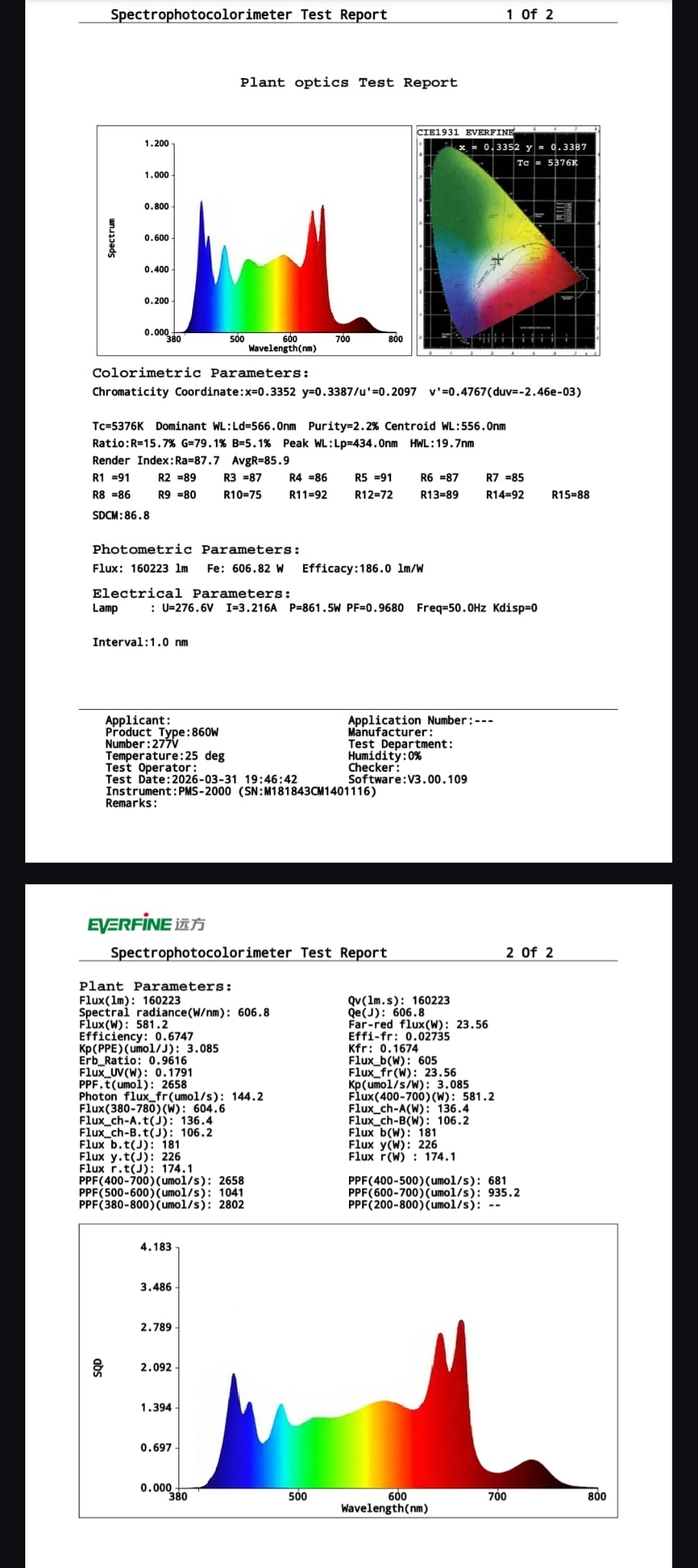
This number comes from integrating sphere measurements, where the total photon output is measured against the electrical input.
Example:
Total PPF: 2497 µmol/s
Power Draw: 803 watts
2497 ÷ 803 = 3.11 µmol/J
That is the true fixture efficiency.
Why Marketing Often Misleads Growers
Many companies manipulate these numbers.
Common tricks include:
Using diode efficiency instead of fixture efficiency
A diode might be 3.14 µmol/J (common advertisement for fixtures using Samsung 301H and 301H Evo chips), but once you include:
- driver losses
- board losses
- thermal losses
The fixture might only be 2.7–2.9 µmol/J.
Reporting unrealistic power draw
Some brands measure efficiency at lower current than the fixture actually runs at.
When you run the fixture at full power, efficiency drops.
Ignoring spectrum
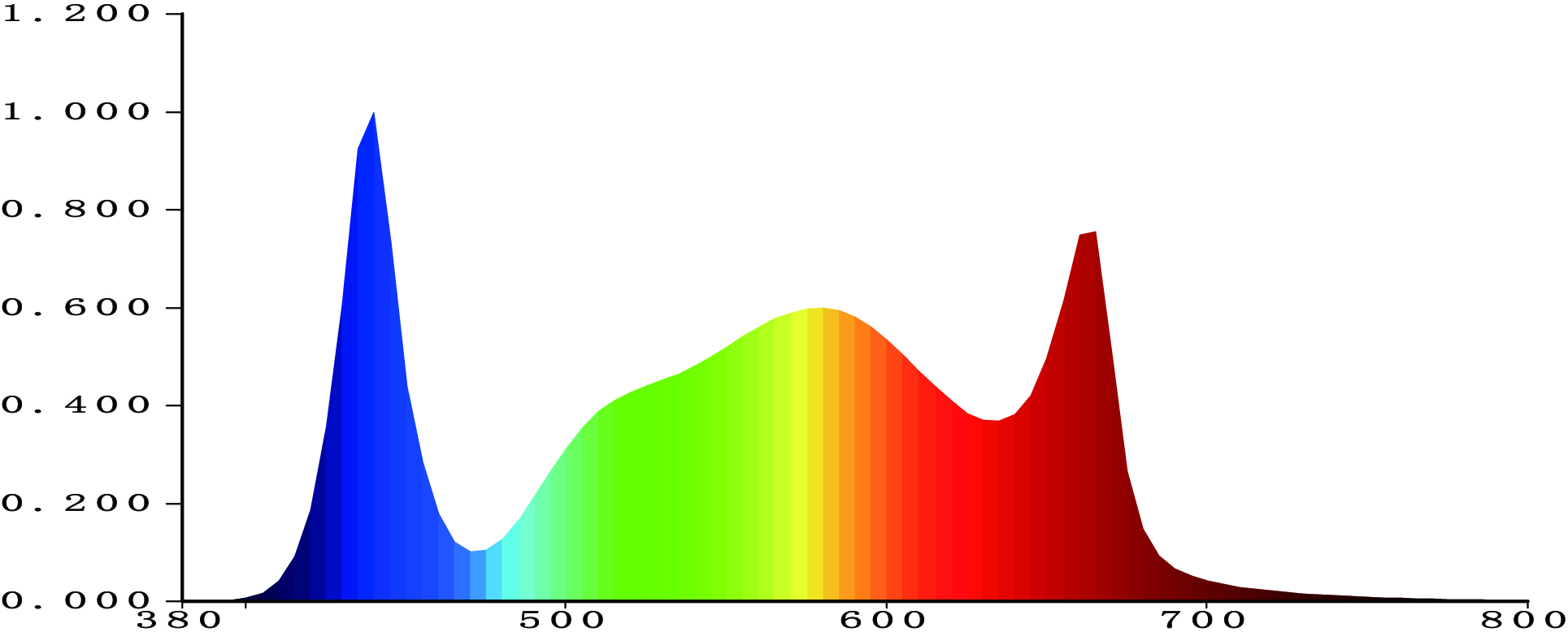
You can artificially inflate efficiency by loading the spectrum with excess red, because red photons are electrically cheaper to produce.
But that does not necessarily produce the best plants.
Efficiency is not the only metric that matters.
Spectrum still matters.
Distribution still matters.
Build quality absolutely matters.
What Growers Should Actually Pay Attention To
When evaluating a light, the real metrics that matter are:
- Fixture PPE (µmol/J) – true electrical efficiency
- Total PPF – how much light the fixture produces
- PPFD map – how evenly that light is distributed
- Spectrum design – how those photons influence plant morphology and chemistry
If any one of these four is weak, the fixture will not perform at the highest level.
Summary
PPF tells you how much light exists.
PPFD tells you how much light your plants receive.
µmol/J or PPE tells you how efficiently the fixture converts electricity into photons.