Why 640nm Appears in Select 2026 ProTerp Fixtures
(And Why Our Stance on “Dual Red Peaks” Hasn’t Changed)
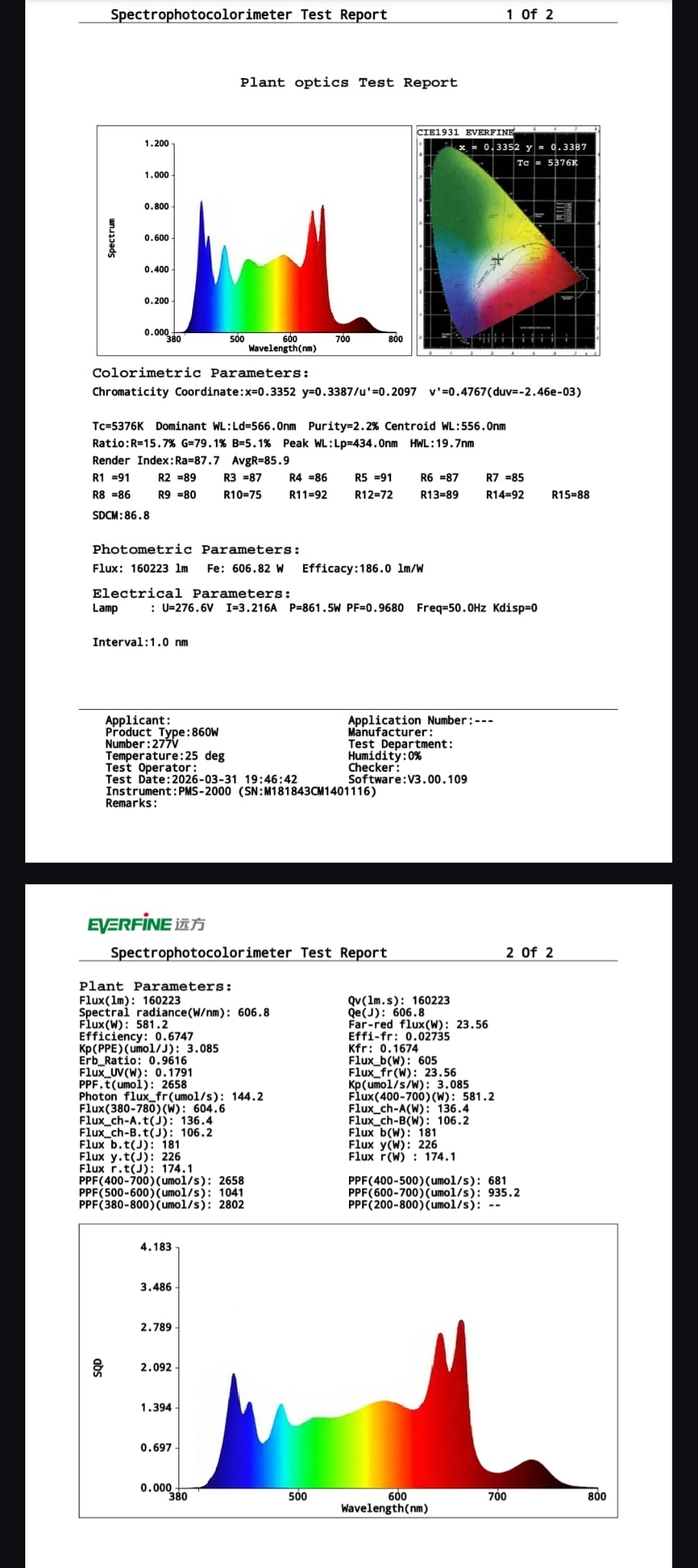
Our baseline target spectrum for the ProTerp Series remains a balanced, Sunlike/CMH-style distribution with ~35% total red output. That configuration is complete, intentional, and fully capable of delivering top-tier results on its own. It does not need 640 nm to “fix” anything.
At the same time, the 2026 ProTerp platform introduces optional refinements for operators who want to push efficiency and spectral precision slightly further. The inclusion of 640 nm in select configurations reflects that refinement, an evolution of the platform, not a replacement of the standard design.
Both options exist within the same design philosophy.
The Standard ~35% Red Spectrum Is the Reference Design
The standard ProTerp spectrum is built to:
-
Deliver a balanced Sunlike/CMH-style curve
-
Maintain strong blue structure with real cyan and green
-
Avoid red-heavy bias while supporting high PPFD
-
Perform consistently across a wide range of environments and grow styles
This is the spectrum we consider the reference point for overall spectral quality and balance. For most growers and most applications, this configuration already represents the optimal balance between spectral fidelity and performance.
What the 640nm Variant Adds — and Why Some Growers May Choose It
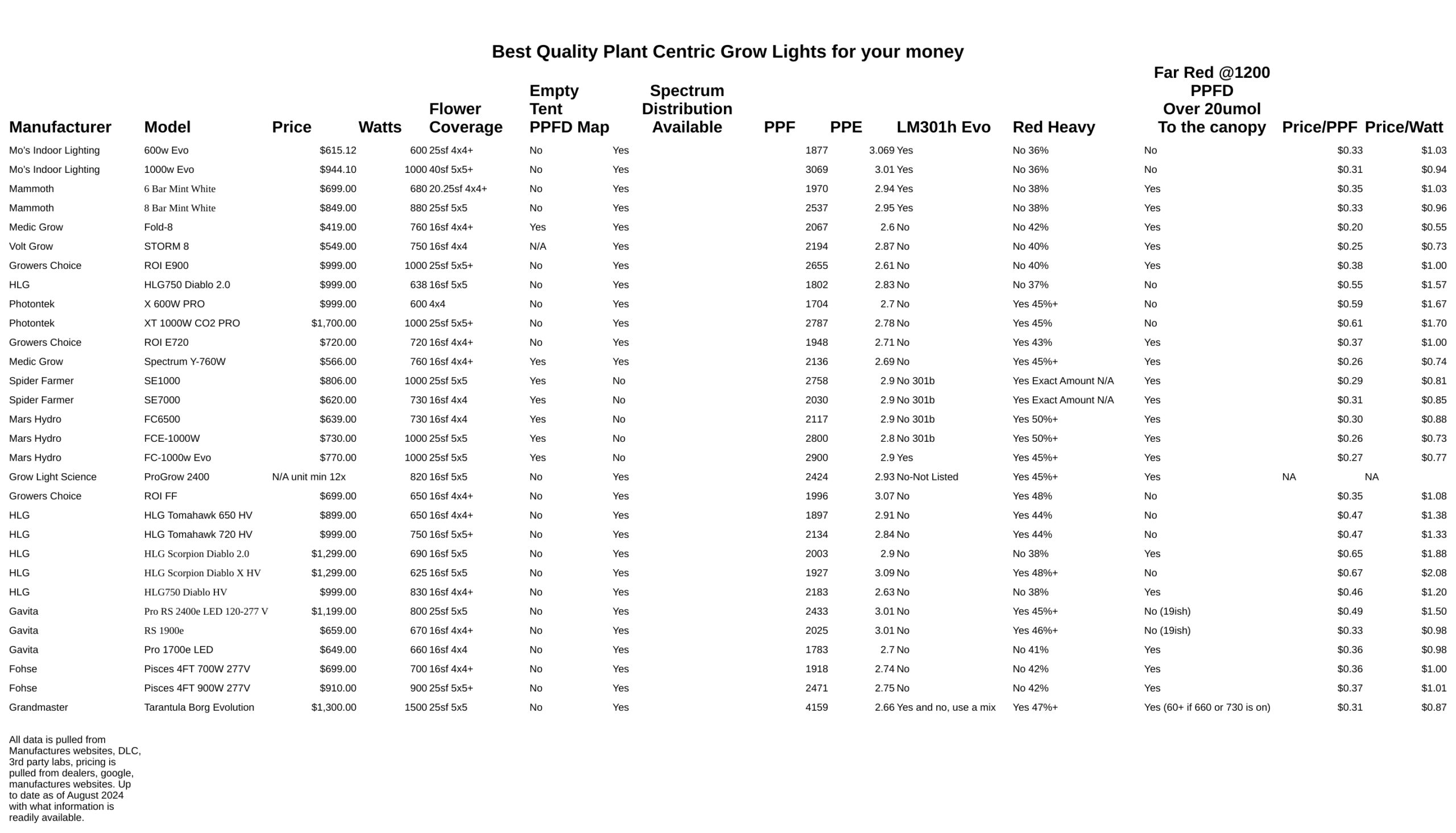
For operators prioritizing maximum electrical efficiency and operating cost per gram — particularly at commercial scale or in regions with high power costs — we offer configurations that push total red toward the upper end of our design window (approaching ~38–40%).
In these higher-efficiency models, the spectral architecture is intentionally adjusted. We reshape how the white base and green components are deployed to improve overall PPE and system efficiency. As a result, the relative photon distribution across the spectrum shifts slightly.
To maintain the same spectral quality and balanced Sunlike/CMH-style character of the ProTerp platform, we compensate for that shift by refining how photons are placed in the red transition region. A controlled amount of 640 nm is used to preserve smooth spectral continuity, maintain the intended curve as red fraction increases, and improve spectral consistency across production runs.
This approach allows us to extract incremental gains in efficiency while preserving the balanced spectral profile that defines the ProTerp Series. It is not intended to suggest fundamentally different plant responses compared to the standard configuration, but rather represents a refinement layered on top of an already complete and balanced spectrum.
Our Position on “Dual Red Peaks” Has Not Changed
It’s important to be clear about what this does not represent.
Our long standing position remains:
Simply adding a second red peak to a fixture, particularly in simplistic blue + red or dual-blue + red configurations does not inherently improve yield, cannabinoid content, or terpene expression at high intensity. “Dual red peaks” as a standalone marketing claim remain largely a branding narrative, not a performance breakthrough.
The 640 nm inclusive ProTerp configurations do not contradict that stance. They are not based on the idea that “more red peaks = better plants.” They exist because, within a fully built-out, Sunlike/CMH-style spectrum that already includes structured blue, cyan, green, and controlled red, finer control over where red photons sit can improve efficiency and spectral fidelity in certain operating envelopes.
Context matters.
Spectrum architecture matters.
Marketing labels still don’t.
The Takeaway
The ProTerp Series is designed as a platform with a clear reference spectrum and optional refinements.
-
The standard ~35% red configuration remains the baseline for balanced, high quality spectral performance.
-
The 640 nm inclusive variants offer a modest, efficiency oriented refinement for growers who want to push operating efficiency and spectral precision slightly further, especially at scale.
Neither approach represents a shift in philosophy, and neither invalidates the other. The addition of 640 nm reflects continued iteration within the same design framework, not a reversal of our position on dual red peaks, and not a departure from the balanced Sunlike/CMH-style spectra that define the ProTerp platform.