For nearly a decade, the formula for building a high-performance LED grow light was fairly straightforward: use efficient white LEDs for most of the output, add 660nm deep red, and optimize the fixture around producing the highest possible PPE.
That approach was not wrong. It represented a major improvement over the narrow red-and-blue fixtures that dominated the early years of LED horticulture.
But LED technology has not stood still.
White LEDs have become more efficient, color-specific diodes have improved, thermal management has advanced, and higher diode densities allow modern fixtures to operate each LED at lower current.
Engineers are no longer forced to choose between an efficient grow light and a more complete spectrum.
That is why the horticultural lighting industry is beginning to move beyond the traditional white-and-deep-red formula and toward broader CMH/Sunlike-inspired spectral designs.
How We Got Here
The earliest LED grow lights relied almost entirely on red and blue diodes. Those wavelengths produced strong photosynthetic responses while offering good electrical efficiency for the technology available at the time.
As white LEDs improved, manufacturers transitioned toward fixtures built primarily around phosphor-converted white diodes with supplemental 660nm deep red.
Compared with older red-and-blue fixtures, these lights produced more natural plant structure, better working visibility, improved crop quality, and substantially greater overall performance.
For years, white plus deep red became the industry standard—and for good reason.
The technology has now advanced again.
The Next Step Is Not Simply More Red
For a long time, maximizing fixture efficacy meant emphasizing wavelengths that produced the greatest number of photons per watt.
Deep-red LEDs are exceptionally effective at doing that.
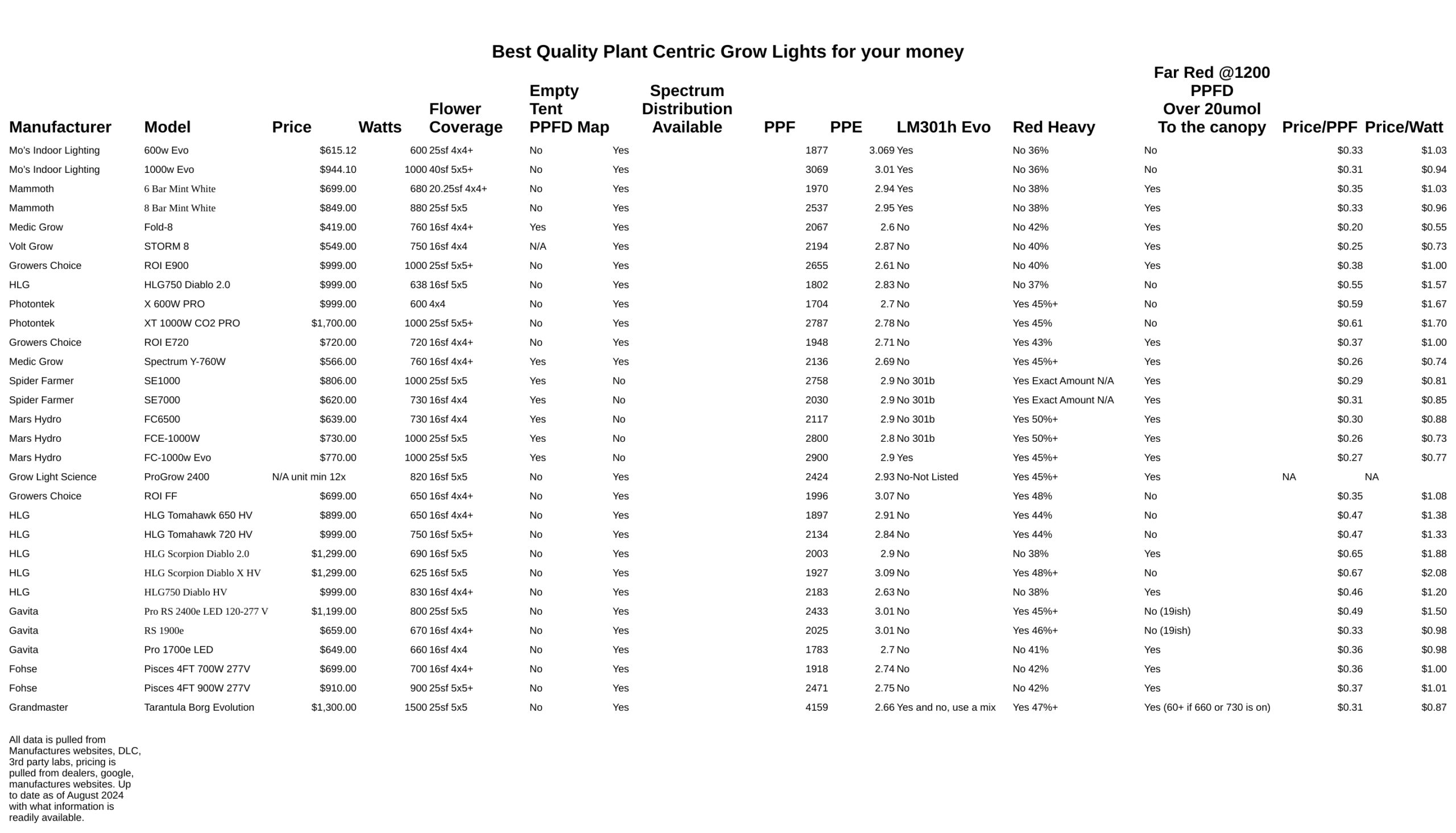
As a result, many fixtures gradually became more red-heavy because that made it easier to produce impressive PPE numbers.
But a horticultural fixture is not judged solely by its integrating-sphere report. Plants respond to the entire light environment they receive, not only the wavelengths that are easiest to generate efficiently.
As LED technology has improved, engineers have gained the freedom to strengthen other parts of the spectrum while still delivering the efficiency expected from a modern fixture.
What Does CMH/Sunlike Spectrum Actually Mean?
The terms CMH-inspired and Sunlike spectrum do not describe one fixed spectral recipe.
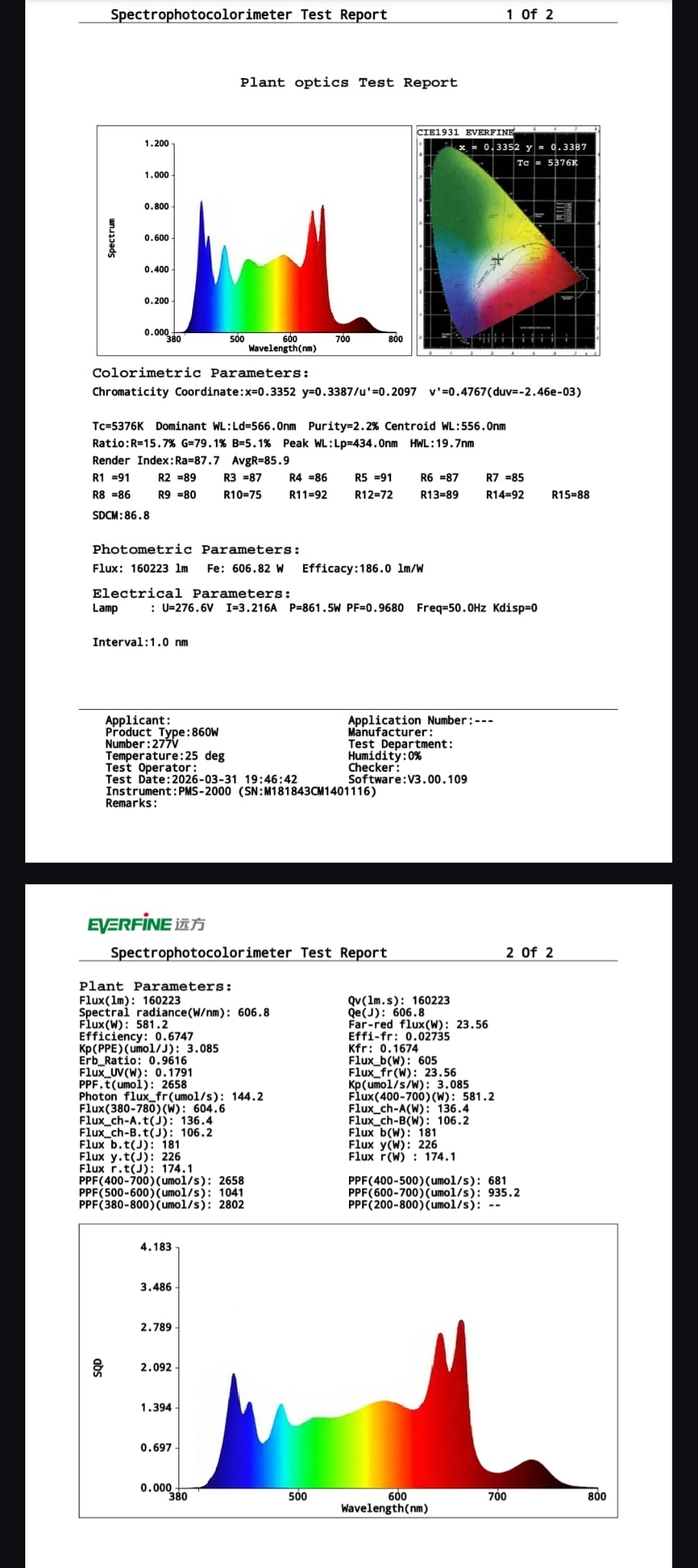
They describe an engineering philosophy built around broader, more continuous spectral output instead of concentrating most of the fixture’s energy into only one major blue peak and one major red peak.
Ceramic metal halide fixtures earned a reputation for producing broad spectral output that many growers associated with excellent plant quality, balanced morphology, strong coloration, and pronounced aromatic expression.
CMH technology could not match the efficiency, lifespan, output, or controllability of today’s best LEDs. However, it demonstrated why a broader distribution of wavelengths could be valuable.
Modern LEDs now allow engineers to reproduce many of those spectral characteristics while retaining the advantages that made LED lighting the industry standard.
Building a More Complete LED Spectrum
Instead of relying almost entirely on white LEDs and 660nm supplementation, a modern CMH/Sunlike-style platform can intentionally reinforce several important spectral regions.
-
437nm Violet-Blue
Complements the conventional 450nm blue peak and strengthens the shorter-wavelength side of the blue region. -
450nm Royal Blue
Provides highly efficient blue output and remains a foundational wavelength in modern horticultural lighting. -
480nm Cyan/Teal
Helps fill one of the most noticeable valleys found between the blue peak and the phosphor-generated portion of many white LEDs. -
525nm Emerald Green
Reinforces a region that is present in white LEDs but is typically much weaker than the yellow-green and yellow portions of their output. -
640nm Red
Broadens the red region and reduces dependence on one isolated deep-red peak. -
660nm Deep Red
Delivers highly efficient photosynthetic output and remains an important component of flowering-focused fixtures. -
730nm Far Red
Can be placed on a separate dimmable channel, depending on the fixture, allowing growers to control its intensity without permanently weighting the main spectrum toward far red.
The objective is not to add more colors simply to create an impressive-looking spectral graph.
The objective is to create a smoother and more complete distribution of usable light using wavelengths that modern LED technology can now produce efficiently.
Do White LEDs Already Produce Green Light?
Yes—but not as evenly as many growers assume.
Most white LEDs begin with a blue pump diode covered by a phosphor layer. The phosphor converts part of the blue output into longer wavelengths, creating light that appears white to the human eye.
The result is broad output, but it is not a flat or evenly distributed spectrum.
Most horticultural white LEDs produce substantial energy through the yellow-green, yellow, and orange portions of the spectrum, particularly from approximately 550–600nm.
They generally produce much less output through the cyan and shorter green regions, especially around 480nm and from approximately 500–525nm.
Dedicated green does not mean white LEDs contain no green.
It means engineers are intentionally reinforcing spectral valleys that standard phosphor-converted white LEDs do not emphasize strongly enough to create the desired spectral balance.
Adding dedicated 480nm cyan and 525nm green diodes is therefore not simply about producing “more green.”
It is about filling specific gaps between the blue pump peak and the dominant phosphor-generated output of the white LEDs.
Why Use Both 437nm and 450nm White LEDs?
Conventional white LEDs are commonly built around a blue pump near 450nm. That creates the familiar blue peak visible in most white-LED spectral graphs.
Newer high-efficiency white LEDs are also available with shorter pump wavelengths near 437nm.
Combining 437nm-pumped and 450nm-pumped white LEDs creates two distinct blue contributions before dedicated cyan and green wavelengths are added.
Rather than relying on a single large blue peak, this approach broadens the short-wavelength side of the spectrum and creates a more gradual transition from violet-blue through royal blue, cyan, and green.
These diodes can now be used at efficiency levels that make them practical in high-output horticultural fixtures instead of limiting them to specialty or low-efficiency applications.
Why Use Both 640nm and 660nm Red?
Many traditional LED grow lights rely almost entirely on 660nm deep red to supplement their white LEDs.
That approach offers excellent photon efficacy, but it can also create one dominant and relatively narrow red peak.
Adding 640nm red spreads output across a broader portion of the red region. The fixture can retain the efficiency and flowering performance associated with 660nm while creating a red distribution that is less dependent on a single wavelength.
The goal is not to eliminate 660nm. It is to use it as part of a broader dual-red architecture.
Why Far Red Should Be Controllable
Far red can affect phytochrome state, shade responses, elongation, leaf expansion, and flowering behavior.
Those responses can be useful, but the desired amount of far red can vary by crop, cultivar, growth stage, intensity, photoperiod, and cultivation strategy.
Permanently mixing a large amount of 730nm far red into the main channel forces the grower to use it whenever the fixture is operating.
Placing far red on an independent dimmable channel provides considerably more control. Growers can reduce it, increase it, or disable it without changing the balance of the core PAR spectrum.
Why Higher Diode Density Matters
One of the main reasons this spectral evolution has become possible has little to do with spectrum itself.
It comes down to how the fixture is built.
When more LEDs share the electrical load, each individual diode can operate at lower current. LEDs generally perform more efficiently at lower drive currents because efficiency droop and heat generation are reduced.
Higher diode density can provide several advantages:
- Higher system-level efficacy
- Lower thermal stress per diode
- Reduced efficiency droop
- Improved long-term reliability
- More stable spectral output over time
- Greater flexibility when combining several diode types
Instead of forcing a smaller number of LEDs to work harder, a high-density platform spreads the workload across thousands of diodes.
Advances in fixture architecture have helped make advances in spectrum practical.
Efficiency Still Matters
Moving toward a broader spectrum does not mean efficiency has become less important.
Electrical efficiency directly affects operating costs, heat production, HVAC demand, and the amount of light a fixture can deliver for every watt consumed.
Those advantages remain just as valuable today as they were ten years ago.
The difference is that modern fixture design no longer has to revolve around efficiency alone.
Improved white LEDs, efficient color diodes, higher diode density, better drivers, and more advanced thermal design now allow engineers to optimize spectrum and electrical performance together.
Why Premium Fixtures Are Beginning to Look More Similar
Compare many of today’s premium horticultural fixtures and an industry-wide direction begins to emerge.
The designs are not identical, and every manufacturer still makes different choices. However, many newer platforms are becoming less dependent on heavily red-weighted spectra and are placing greater emphasis on broader spectral distribution.
That does not necessarily mean companies are copying one another.
It means they are responding to the same improvements in LED technology and reaching similar conclusions about what is now possible.
The details differ. The overall direction is becoming increasingly clear.
Looking Beyond a Single Specification
Growers naturally compare fixtures using wattage, PPF, PPE, and price. Those measurements are important, but no single number describes the complete performance of a grow light.
Spectrum, diode density, photon distribution, canopy uniformity, thermal management, driver quality, controllability, reliability, and long-term consistency all influence how a fixture performs in a real cultivation environment.
The best grow lights are not engineered around one specification.
They are engineered as complete systems.
Where Horticultural Lighting Is Headed
The future of grow lighting will not be defined by one revolutionary wavelength or one record-breaking efficiency number.
It will be shaped by the continued integration of better LEDs, higher diode densities, improved thermal engineering, more precise spectral control, and increasingly refined fixture architecture.
Modern CMH/Sunlike-inspired LEDs represent that next step—not because they recreate the inefficiencies of ceramic metal halide lighting, but because they bring the concept of a broader, more complete spectrum into an efficient and controllable LED platform.
As component technology continues to advance, spectrum will become just as important as efficiency in defining the next generation of horticultural lighting.